

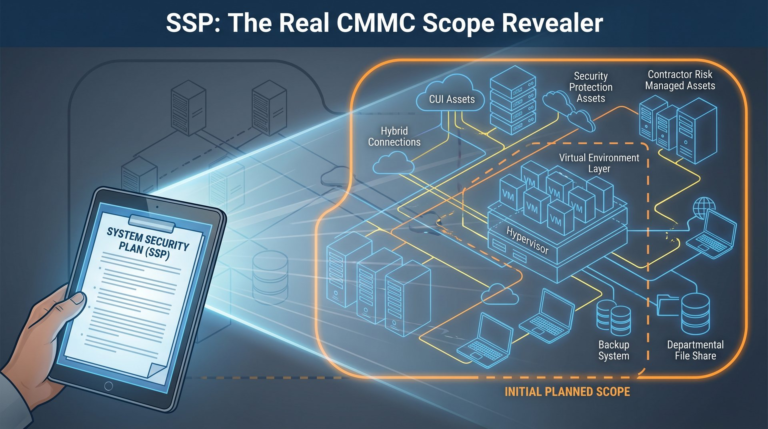
Most DIB contractors view the System Security Plan (SSP) as a documentation hurdle, write down your security controls, describe your environment, check the box. But here’s what they discover too late: developing your SSP is actually when you find out your real CMMC scope is bigger than you thought.
The SSP isn’t just paperwork. It’s a forcing function that makes you map every system, connection, and data flow in your CUI environment. And that mapping process? That’s where contractors get their first real look at what they’re actually committing to protect.
The Asset Discovery Problem
The first tip for SSP implementation always sounds simple: “gain visibility into your assets.” But when contractors actually start cataloging systems that process, store, or transmit CUI, they uncover complexity they didn’t budget for.
That departmental file share that occasionally gets CUI? Now it’s in scope. The backup system that mirrors your CUI database? Also in scope. The laptop that remotely accesses the CUI environment? That needs to be evaluated too.
This isn’t about being overly inclusive, it’s about following the CMMC asset categorization methodology. Every system touching CUI must be evaluated as either a CUI Asset, Security Protection Asset, Contractor Risk Managed Asset, or Specialized Asset. You can’t make those determinations without first discovering what exists.
Operating Model Reality Check
Evaluating your operating model, the second major SSP component, forces another uncomfortable realization. Your SSP must document the full topology of your IT infrastructure, including all system boundaries and interconnections.
This is where hybrid environments reveal their true complexity. That “simple” setup with some data in Microsoft GCC High and some on-premises? Your SSP must map every connection between them. Each boundary crossing needs controls. Each integration point needs documentation.
Virtual environments add another layer. If you’re running virtual machines that process CUI, your SSP must capture not just the VMs but the underlying infrastructure. The hypervisor, the management plane, the storage layer, they all become part of your security boundary.
The Documentation Trap
Here’s what makes this especially painful: you can’t just document what you wish you had. The SSP must reflect your actual environment. This means if your asset discovery reveals 50 systems in scope instead of the 10 you planned for, your SSP must address all 50.
And since the SSP is an iterative document, updated whenever you make significant security changes, this isn’t a one-time problem. Every technology refresh, every new integration, every architectural change triggers an SSP update and potentially expands your scope.
What This Means for Your CMMC Timeline
The contractors who struggle most with CMMC are those who start their SSP late, treating it as a documentation exercise after they think they’ve defined their scope. By then, the cost of discovering expanded scope can derail budgets and timelines.
Smart contractors flip this: they use early SSP development as their scoping validation tool. Before they lock their boundary, before they size their remediation effort, before they estimate assessment costs, they map their actual environment through the SSP lens.
The worst time to discover your scope is three times larger than budgeted? During your C3PAO assessment. The second worst time? When you’re trying to rush an SSP together for your assessment package. Start the discovery process early, even if it reveals uncomfortable truths about your environment’s complexity.
Don’t wait until Phase 1 of your assessment process to find out your SSP reveals scope you never accounted for. That discovery process needs to happen now, while you still have time to make informed decisions about boundary reduction, system isolation, or even whether CMMC Level 2 makes sense for your business model. Get clarity on your real scope before you commit resources you can’t get back. Learn more about validating your CMMC scope →