



Protect your contracts and your team’s focus with straightforward CMMC guidance
Organizations handling controlled information must now demonstrate that they meet a defined set of security standards in order to remain eligible for defense work. Certification verifies that your cybersecurity practices are consistent, measurable, and capable of protecting sensitive data across the defense supply chain. A vast majority of contracts will include CUI and require a Level 2 Third Party Certification.
What Is the Cybersecurity Maturity Model Certification (CMMC)?
The Cybersecurity Maturity Model Certification (CMMC) is a cybersecurity framework established by the U.S. Department of Defense to protect Controlled Unclassified Information (CUI) and Federal Contract Information (FCI) across the defense supply chain. It applies to DoD prime contractors and subcontractors whose systems store, process, or transmit this data while performing DoD work.
CMMC uses a tiered certification model that defines the cybersecurity practices contractors must meet to be eligible for DoD contracts. Each level represents increasing cybersecurity maturity, ensuring that protections scale with the sensitivity of the information involved and the risk posed by the mission or contract.

Most CMMC requirements are not new. They are rooted in longstanding DoD obligations, particularly those established through Defense Federal Acquisition Regulation Supplement requirements and security controls outlined in NIST SP 800-171. What CMMC changes is enforcement. Instead of relying primarily on self-attestation, CMMC requires formal validation that these controls are implemented and sustained.
In practice, CMMC shifts cybersecurity compliance from a paperwork exercise to verified performance. Contractors must demonstrate effective controls across areas such as access management, incident response, configuration management, and risk assessment. This strengthens protection of government data, creates consistency across the defense industrial base, and improves overall cyber resilience for organizations that operate in both government and commercial environments.
CMMC applies to DoD prime contractors and subcontractors at any tier that process, store, or transmit Federal Contract Information (FCI) or Controlled Unclassified Information (CUI) while performing DoD work. Requirements are enforced through contract language, including DFARS clauses, and primes are obligated to flow down the appropriate cybersecurity requirements to subcontractors when subcontract performance involves Covered Defense Information.
Why flow-down gets complicated?
Flow-down is not a blanket requirement applied to every vendor. It depends on what information a subcontractor will actually access and what the prime contract specifically requires:
Primes typically ask for proof, not promises: expect requests for an SSP/POA&M posture, incident reporting readiness, and other evidence that you can meet DFARS/NIST expectations.
CMMC Level 1 draws from Federal Acquisition Regulation (FAR) 52.204-21, which does not use the NIST 800-171 domain structure. To maintain consistency across the model, the 15 Level 1 safeguards are aligned to 6 of the 14 NIST 800-171 domains.
Level 1 contains 15 controls, all sourced directly from FAR 52.204-21(b)(1). These are considered the minimum security requirements for any contractor who processes, stores, or transmits Federal Contract Information (FCI).
Across the 15 controls, Level 1 includes 30 assessment objectives. Each control is unpacked into one or more objective-level actions that you must demonstrate during a self-assessment.
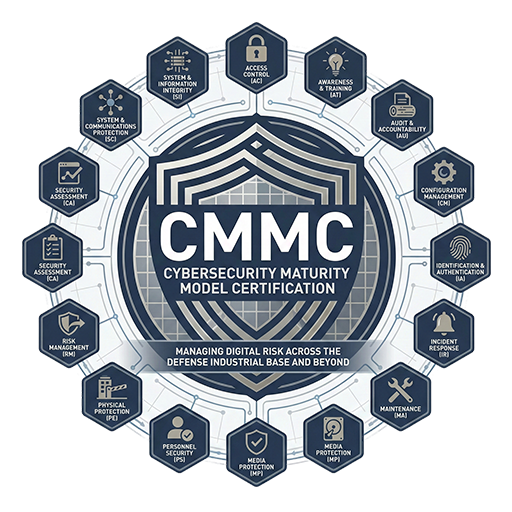
CMMC is built on NIST 800-171 and organized into 14 domains. Each domain covers a different slice of your security program, creating a broad surface area that many teams underestimate at the start.
Within those domains sit 110 controls. The controls set the requirement, but the real challenge shows up underneath them—every control is unpacked into multiple assessment objectives, each one representing a specific action you must demonstrate.
Within the 110 controls are 320 assessment objectives. Each objective represents a specific, testable action that must be performed, documented, and traceable to the requirement. While controls describe what must be achieved, objectives define the exact conditions an assessor will evaluate.
There are additional security requirements introduced at Level 3, derived from NIST SP 800-172, and layered on top of the Level 2 baseline to address advanced threats.
Assessment objectives are the individual evaluation criteria used during a CMMC Level 3 assessment to verify that security requirements are implemented, operating as intended, and producing the expected security outcomes. This includes all Level 2 assessment objectives plus additional objectives associated with the Level 3 enhanced requirements.

The Cybersecurity Maturity Model Certification (CMMC) is a cybersecurity framework established by the U.S. Department of Defense to protect Controlled Unclassified Information (CUI) and Federal Contract Information (FCI) across the defense supply chain. It applies to DoD prime contractors and subcontractors whose systems store, process, or transmit this data while performing DoD work.
CMMC uses a tiered certification model that defines the cybersecurity practices contractors must meet to be eligible for DoD contracts. Each level represents increasing cybersecurity maturity, ensuring that protections scale with the sensitivity of the information involved and the risk posed by the mission or contract.

CMMC applies to DoD prime contractors and subcontractors at any tier that store, process, or transmit Federal Contract Information (FCI) or Controlled Unclassified Information (CUI) while performing DoD work.
These requirements are enforced through DoD contract language, including DFARS clauses. Prime contractors are responsible for flowing down applicable cybersecurity requirements when subcontractor performance involves Covered Defense Information.
Why flow-down gets complicated
Flow-down is not a blanket requirement for every vendor. It depends on the type of information a subcontractor will access and the specific requirements of the prime contract.
Primes typically request evidence, not assurances. Subcontractors should expect requests for SSPs, POA&Ms, incident response readiness, and other proof that DFARS and NIST requirements are being met.
High-level security areas used to organize requirements.
Level 1 assesses practices across 6 of the 14 domains.
Basic security practices required to protect Federal Contract Information (FCI).
FAR 52.204-21 defines 17 safeguarding requirements.
15 are assessed under CMMC Level 1, while the remaining 2 requirements are enforced through DFARS contract obligations and are not directly assessed as CMMC practices.
Across the 15 controls, Level 1 includes 30 assessment objectives. Each control is unpacked into one or more objective-level actions that you must demonstrate during a self-assessment.
CMMC is built on NIST 800-171 and organized into 14 domains. Each domain covers a different slice of your security program, creating a broad surface area that many teams underestimate at the start.
Within those domains sit 110 controls. The controls set the requirement, but the real challenge shows up underneath them—every control is unpacked into multiple assessment objectives, each one representing a specific action you must demonstrate.
Because CMMC is rooted in one of the most technically demanding federal standards, organizations need support that understands both the NIST 800-171 framework, and how assessors evaluate it.
We translate every requirement into plain language, map your environment against those expectations, establish your SPRS score, and lay out a prioritized roadmap for closing the gaps.
CMMC’s documentation and evidence demands go far beyond what most teams experience in ISO, SOC, or traditional quality standards. The level of detail, repeatability, and assessor-verified proof required to pass and to stay ready surprises even mature organizations.
We help you understand what “ready” truly means, build the documentation and evidence needed to support every objective, and guide your team through a process that is far more structured and intensive than anything they have prepared for before.
There are controls that, if not fully met, will result in a failed assessment. We help you understand the subtle differences between look-alike domains, how assessors verify each requirement, and where overlap can create confusion.
By clarifying these distinctions and guiding you in mapping the right evidence to the right objectives, we help you avoid the ‘close enough’ assumptions that lead to objective-level misses that stop the assessment.
CMMC readiness is not a one-time event. It requires consistent practices, documented habits, and ongoing proof that your security program is working every day. Many organizations underestimate the effort needed to maintain a culture that supports the CMMC requirements.
We help you build simple, repeatable processes that keep your evidence current, your activities tracked, and your team aligned so you remain ready long after the initial assessment
The official FAR clause lists 15 safeguards, but CMMC documentation often references 17 practices. Here is why:
CMMC inherited the DoD’s earlier mapping from the DFARS 252.204-21 “Basic Safeguarding” table, where two of the FAR requirements were split into multiple CMMC practice IDs during modeling. They are not additional requirements—just a structural carryover from the original DoD-to-NIST mapping exercise.