

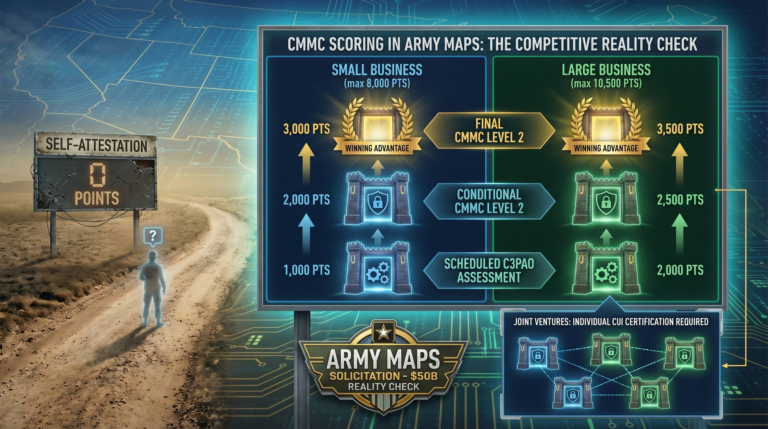
The Army just dropped a $50B reality check on the Defense Industrial Base. Their Marketplace for Acquisition of Professional Services (MAPS) solicitation isn’t just another contract announcement, it’s the first major reveal of how CMMC Level 2 certification will translate into competitive advantage (or disadvantage) in federal contracting.
Here’s what DIB contractors need to understand: MAPS shows exactly how the DoD will score CMMC compliance when Phase 2 of the implementation rollout begins. And the scoring model has teeth.
The Numbers That Matter
MAPS establishes a clear scoring hierarchy that will likely become the template for future DoD solicitations:
For small businesses (under 500 employees):
- Scheduled C3PAO assessment: 1,000 points
- Conditional CMMC Level 2 (C3PAO): 2,000 points
- Final CMMC Level 2 (C3PAO): 3,000 points
- Maximum CMMC-related points: 8,000
For large businesses (500+ employees):
- Scheduled C3PAO assessment: 2,000 points
- Conditional CMMC Level 2 (C3PAO): 2,500 points
- Final CMMC Level 2 (C3PAO): 3,500 points
- Maximum CMMC-related points: 10,500
Notice what’s missing? Self-attestation. While CMMC Level 2 self-assessment meets the minimum eligibility requirement, it scores exactly zero points. That’s 38% of available scoring for small businesses and 33% for large businesses left on the table.
Joint Ventures Face Multiplied Requirements
The MAPS solicitation clarifies a critical point about joint ventures: each JV member that will handle CUI must maintain individual CMMC certification. This isn’t a case where one certified partner can carry the others. Every organization touching CUI needs their own validated compliance status in SPRS.
This requirement fundamentally changes how contractors approach teaming arrangements. You can’t hide behind a prime’s certification anymore, if you’re handling CUI as part of the JV, you need your own CMMC Status.
What This Signals for Phase 2
While MAPS technically falls within the DoD’s Phase 1 implementation period (primarily focused on self-assessments), it’s clearly built for Phase 2 readiness. The scoring structure sends an unmistakable message: C3PAO assessments aren’t just preferred, they’re becoming the competitive baseline.
This aligns with what we know from 32 CFR Part 170 about the phased implementation approach. Phase 1 allows flexibility, but smart contractors are reading the writing on the wall. When Phase 2 arrives and C3PAO assessments become more common in solicitations, contractors who waited will find themselves at a significant scoring disadvantage.
Practical Takeaways
Start your C3PAO assessment planning now. Even if you’re not bidding on MAPS, this scoring model shows where DoD procurement is headed. A scheduled assessment gets you points; a completed one gets you more.
Validate your JV strategy. If you typically team with other contractors, ensure everyone handling CUI understands they’ll need individual certification. This isn’t optional language, it’s a hard requirement.
Check your SPRS status. MAPS requires proof of CMMC status through SPRS validation. If you haven’t submitted your self-assessment scores or updated your status recently, you’re not ready to bid.
The most expensive time to discover you misunderstood CMMC requirements is when you’re disqualified from a major contract opportunity. If you’re unclear on how your current compliance approach translates to actual scoring in competitive solicitations, that’s exactly what a scoping conversation clarifies, before you invest in the wrong certification path.
—